Follow along with the video below to see how to install our site as a web app on your home screen.
Note: This feature may not be available in some browsers.
This board is now closed. The Blackhole image ended in 2020.
The board will remain available in Read Only Mode, so all the posts from the last 15+ years are not lost.
We thank you for being part of the community for the last 15+ years.
You can join the OpenBh board if you have not already done so at www.openbh.net.
hello to everyone, I just got my duo + saw a week ago, it's really good receiver especially after you installed BH144. I want to know is can I connect my vu+ duo a sony téléveseur who owns a YCrCb component input: Digital? or it just works with YPrPb: analog?
Read this, then see Vu+ manual
(www.olvix.lv/download/manual/sat/VUplus_manual_engels.pdf) U will find what U looking for.
The YUV standard
The YUV standard (also called CCIR 601), known before as YCrCb (Y Cr Cb), is a colour representation model dedicated to analogue video. It is based on a video transmission mode with separate components using three different cables to carry information regarding luminance (luminosity) and the two chrominance (colour) components. . It is the format used in the PAL (Phase Alternation Line) and SECAM (Séquentiel Couleur avec Mémoire) standards. The Y parameter represents the luminance (i.e. information in black and white), while U and V make it possible to represent the chrominance (i.e. information regarding the colour). This model was developed in order to allow colour information to be transmitted to colour television sets, while making sure that the existing black and white television sets continue to display an image in tones of grey. The following are the relationships between Y and R, between G and B, between U, R and luminance, and finally, between V, B and luminance:
Y = 0.299R + 0.587 G + 0.114 B
U = -0.147R - 0.289 G + 0.436B = 0.492(B - Y)
V = 0.615R -0.515G -0.100B = 0.877(R-Y)
Thus, U is sometimes written as Cr and V is sometimes written as Cb, hence the notation YCrCb. Cabling
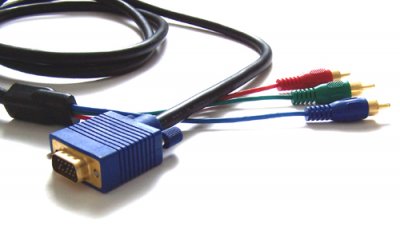
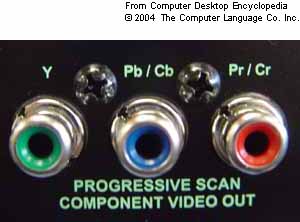
A YUV connection is thus usually based on the use of three RCA cables, one green, one blue and one red:
YUV connection makes it possible to offer an optimal video quality by simultaneously sending the 576 rows of the image, without interlacing (all at once).
YUV : known before as YCrCb (Y Cr Cb), is a colour representation model dedicated to analogue video.""
so U telling me they are wrong.....! In short HDMI is your best connection for video (or DVI), it is digital format.
Or U can use scart cable it will give digital video and sound!
One of two primary color spaces used to represent digital component video (the other is RGB). The difference between YCbCr and RGB is that YCbCr represents color as brightness and two color difference signals, while RGB represents color as red, green and blue. In YCbCr, the Y is the brightness (luma), Cb is blue minus luma (B-Y) and Cr is red minus luma (R-Y). See component video.
YCbCr Is Digital
MPEG compression, which is used in DVDs, digital TV and Video CDs, is coded in YCbCr, and digital camcorders (MiniDV, DV, Digital Betacam, etc.) output YCbCr over a digital link such as FireWire or SDI. The ITU-R BT.601 international standard for digital video defines both YCbCr and RGB color spaces. See YCbCr Sampling.
YPbPr Is Analog
YPbPr is the analog counterpart of YCbCr. It uses three cables for connection, whereas YCbCr uses only a single cable (see YPbPr). See YUV, YUV/RGB conversion formulas and ITU-R BT.601.
you want me to give the scheme of your cable? because I made it myself one day but its not working if one plugs into a YCrCb, because the VGA provides an analog signal!!
YPbPr Is Analog
YPbPr is the analog counterpart of YCbCr. It uses three cables for connection, whereas YCbCr uses only a single cable (see YPbPr). See YUV, YUV/RGB conversion formulas and ITU-R BT.601.
This site uses cookies to help personalise content, tailor your experience and to keep you logged in if you register.
By continuing to use this site, you are consenting to our use of cookies.



 !
!